
Storyboard Examples From Famous Films
Study famous movie storyboard examples, film storyboard references, the artists behind them, and what filmmakers can learn from visual planning.
The best storyboard examples from film history are not just pretty drawings. They are decisions made visible. A great board can show where the camera belongs, how the audience should feel, how a scene should cut, what a visual effect must accomplish, and why one image has to follow another.
That is why famous movie storyboards are so useful to study. They reveal a film before the film exists. In some cases, they helped sell the project. In others, they protected a difficult sequence from chaos. And sometimes they became the director’s private map for tone, color, blocking, performance, and editorial rhythm.
This guide looks at famous storyboard examples from live-action cinema, animation, science fiction, horror, and action filmmaking. The goal is not to rank the “best” boards ever drawn. It is to understand why certain storyboards are still worth studying, who made them, and what modern filmmakers can borrow from them.
If you are searching for storyboard references for a short film, AI video project, pitch deck, or shot list, treat the examples below as practical models. Each one shows a different job a board can do: clarify geography, sell tone, protect a reveal, plan visual effects, or turn a director’s idea into something every department can follow.
For an AI-video-specific version of this workflow, read the companion guide to storyboard examples for AI video production.
Key takeaways
Famous storyboards usually matter because they solved a production problem before the crew reached the set, stage, or animation desk.
- The best storyboard examples clarify camera position, screen direction, rhythm, scale, and emotional focus.
- Storyboard credit is sometimes shared or fuzzy, especially on large studio films.
- Some directors draw boards themselves; others rely on dedicated storyboard artists, production illustrators, or story departments.
- Boards can work as an editing plan, a design plan, an effects plan, or a pitch document.
- Movie storyboard examples are most useful when you study what each panel solves, not just how polished the drawing looks.
- Modern AI filmmakers can use the same principles to turn ideas into scenes, shots, references, prompts, takes, and dailies.
What makes a storyboard great?
A storyboard is great when it does more than illustrate the script. It should answer questions the script cannot answer alone.
Good boards tell the crew:
- Where the camera sits.
- What the audience should notice first.
- How movement travels through the frame.
- Where the edit point might be.
- What visual information must stay consistent.
- Which departments need to solve something before production begins.
The most useful film storyboard examples tend to fall into a few types.
| Storyboard type | What it solves | Why it matters |
|---|---|---|
| Action board | Geography, screen direction, momentum | Prevents action from becoming visual noise |
| Horror or suspense board | Timing, reveal, implication | Lets the audience imagine more than they see |
| Production design board | Scale, set layout, atmosphere | Aligns sets, effects, camera, and lighting |
| Animation board | Performance, character business, pacing | Lets story and acting evolve before animation |
| VFX board | Shot purpose, elements, compositing needs | Gives effects teams a concrete target |
| Pitch board | Tone, sequence logic, ambition | Helps producers and studios understand the movie |
Keep those jobs in mind as you read the examples below. The artwork is important, but the production thinking behind it is the real lesson.
How to read movie storyboard examples
The easiest way to learn from famous movie storyboard examples is to read them like production documents, not like finished illustrations. A beautiful panel can still be weak if it does not tell the crew what has to happen next. A rough sketch can be excellent if it locks the camera, action, and edit into place.
When you study storyboards for movies, ask six questions:
- What is the shot’s purpose: setup, reveal, pursuit, reaction, transition, or payoff?
- Where is the camera, and what does that position make the audience feel?
- What moves inside the frame, and what stays fixed?
- How does the panel preserve screen direction or geography?
- What detail must carry into the next shot for continuity?
- Which department would use this panel: camera, art, stunts, VFX, editorial, animation, or sound?
That kind of reading turns storyboarding examples into usable references. You are no longer copying the surface of Psycho, Star Wars, or Mad Max: Fury Road. You are borrowing the decision-making behind the image.
Film storyboard examples by production problem
Use this quick map when you need storyboard references for a specific scene type.
| If your scene needs to… | Study these examples | What to borrow |
|---|---|---|
| Make scale feel cinematic | Gone with the Wind, Ran | Camera distance, figure scale, crowd order, weather, visual hierarchy |
| Build dread or suspense | Psycho, Alien | Withheld information, fragmentary framing, timing, off-screen threat |
| Keep action readable | Star Wars, The Matrix, Mad Max: Fury Road | Screen direction, targets, obstacles, cause and effect |
| Sell a world before it exists | Blade Runner, Jodorowsky’s Dune | Architecture, atmosphere, props, silhouettes, tonal consistency |
| Develop animated performance | Snow White, Spirited Away | Character business, expression, pacing, emotional progression |
| Prepare AI video generation | Any sequence with clear shot intent | References, camera notes, prompt constraints, review criteria |
For a modern AI pipeline, this is where film language meets tooling. The Seedance 2.0 shot planning workflow shows how to translate a board into shot-level generation inputs, while the multi-shot Seedance workflow focuses on keeping longer sequences coherent.
Famous storyboard examples worth studying
Use this as a working film-history map. Several of these examples involve large teams, so the credit line names the commonly cited storyboard artist, production illustrator, director, or story department most associated with the boards.
| Film | Storyboard or visual planning credit | Why it is famous |
|---|---|---|
| Gone with the Wind | William Cameron Menzies | Epic production design mapped as camera logic |
| Snow White and the Seven Dwarfs | Disney story department, with design influence from Albert Hurter and Gustaf Tenggren | Feature animation storyboarding as industrial process |
| Psycho | Saul Bass, with Alfred Hitchcock and the production team | Editing, implication, and terror planned before shooting |
| Star Wars original trilogy | Joe Johnston, Alex Tavoularis, Ivor Beddoes, Roy Carnon, Ralph McQuarrie, and others | Space action made readable before visual effects existed |
| Alien | Ridley Scott’s “Ridleygrams” | Director boards used to sell tone, design, and budget |
| Ran | Akira Kurosawa | Painted boards as color, blocking, and emotional architecture |
| Blade Runner | Sherman Labby | Noir science fiction translated into atmosphere and scale |
| Jodorowsky’s Dune | Jean “Moebius” Giraud with Alejandro Jodorowsky | A legendary unmade film preserved as a visual bible |
| The Matrix | Steve Skroce, Tani Kunitake, Geof Darrow, and the Wachowskis’ art team | Comic-book precision used to pitch and build a new action language |
| Mad Max: Fury Road | Peter Pound, Brendan McCarthy, and the storyboard team | Action cinema structured almost entirely through boards |
| Spirited Away | Hayao Miyazaki | Storyboards as the living screenplay of an animated world |
This list mixes famous storyboards, famous movie storyboard examples, and broader film storyboard references. Some survive as published books, museum holdings, studio archive posts, or frame comparisons rather than full production binders. That is normal. For research, even a partial sequence can teach you how a filmmaker planned staging, rhythm, and visual emphasis.
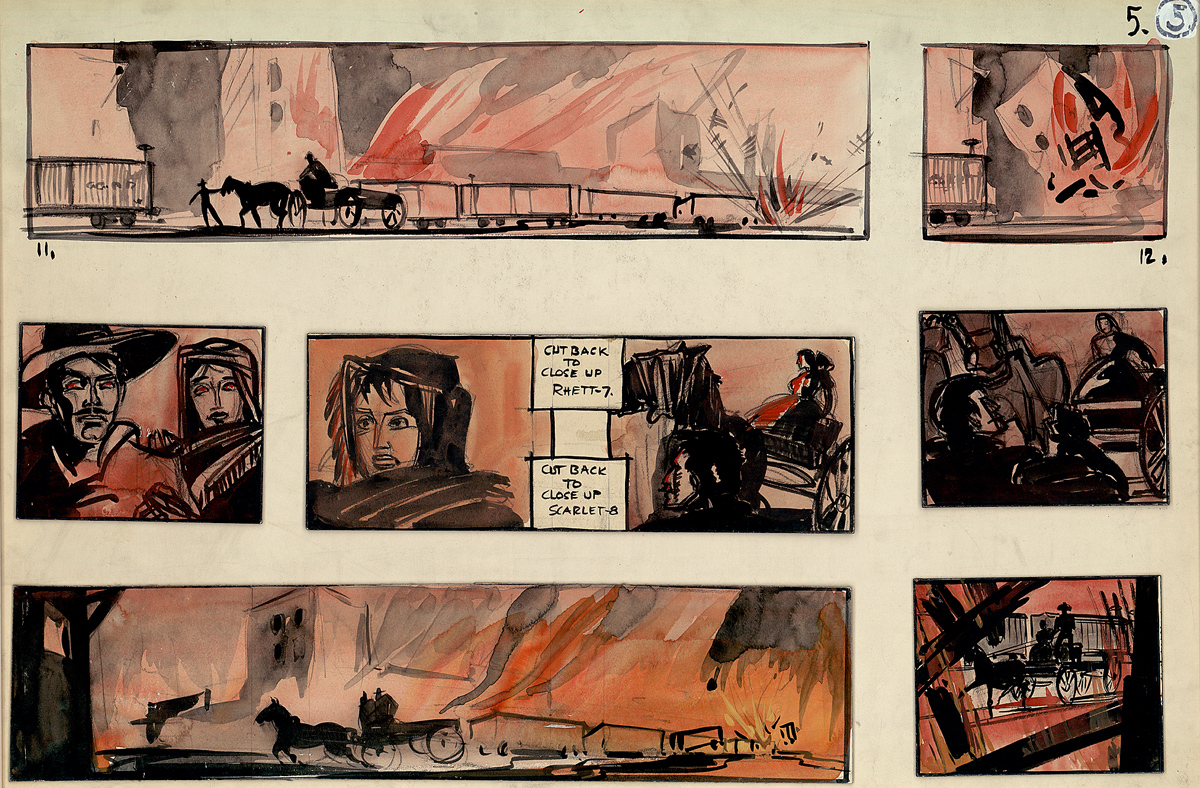
1. Gone with the Wind: William Cameron Menzies and the image before the set
One of the most important early live-action storyboard examples comes from Gone with the Wind. Production designer William Cameron Menzies is closely associated with the film’s extensive previsualization, especially the epic visual planning around sequences such as the burning of Atlanta.
Image source: EatDrinkFilms.

What makes these boards extraordinary is not only their age. It is their authority. Menzies was not sketching decorative thumbnails after the real production decisions had already been made. His images helped define how the movie would look, how sets would be staged, and how large-scale spectacle could be controlled.
The production design context matters. The role “production designer” became connected to Menzies because his job exceeded ordinary art direction. He was shaping the visual system of the movie.
Why it works:
- The boards think in camera angles, not only set illustrations.
- The scale of the frame is clear before the crew builds or lights anything.
- Production design, effects, and camera planning are fused into one visual plan.
- The board helps the sequence feel designed rather than merely expensive.
What filmmakers can learn:
If a scene depends on scale, draw scale first. Before writing “massive crowd,” “burning city,” or “war-torn street” into a prompt or shot list, decide where the viewer stands and what the frame must prove.
Source note: conservation notes on Gone with the Wind storyboards identify Menzies as production designer, while the Harry Ransom Center and related exhibition writing have long discussed the film’s visual planning. See the conservation article on a Gone with the Wind storyboard.
2. Snow White and the Seven Dwarfs: Disney turns story into a wall
Snow White and the Seven Dwarfs is essential to storyboard history because it shows storyboarding becoming a repeatable studio method. Disney’s feature animation process depended on story sketches, gag development, character business, sequence order, and wall-mounted visual thinking that could be revised before costly animation began.
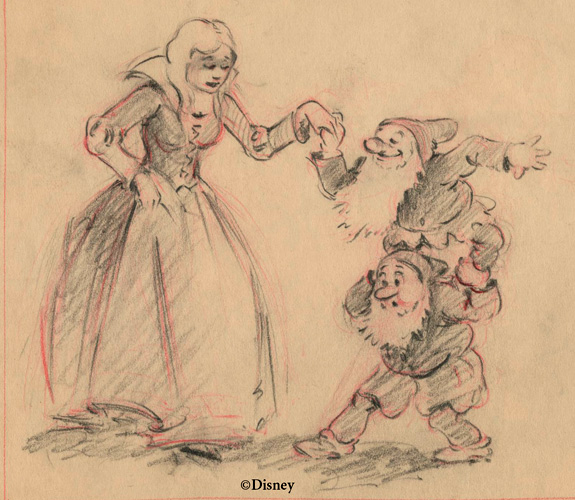
Image source: The Codex.

The credit here is necessarily broad. The film was shaped by Disney’s story department and many artists. The Walt Disney Family Museum notes that its Snow White exhibition included conceptual drawings, character studies, story sketches, and animation drawings. D23 also identifies artists such as Ferdinand Horvath and Gustaf Tenggren as important contributors to the film’s visual world, while Albert Hurter is widely associated with the film’s design influence.
What makes these boards amazing is that they are about performance. The dwarfs are not merely placed in a scene. They behave. They react. They misunderstand. They become readable characters before they become finished animation.
Why it works:
- The boards let story, acting, and comedy evolve together.
- Character personalities are visible in posture and timing.
- The board process protects animation from wasted labor.
- The sequence can be judged emotionally before it is polished.
What filmmakers can learn:
Do not wait for final rendering to discover whether a character beat works. A rough board should already tell you if the audience understands who is scared, who is curious, who is hiding something, and who owns the scene.
Source note: the Walt Disney Family Museum’s Snow White exhibition describes the production artwork shown for the film, and D23’s Snow White history notes the role of artists who shaped the film’s world.
3. Psycho: Saul Bass and the violence you do not see
The shower scene in Psycho is one of the most famous storyboard case studies in film history. The exact authorship and degree of Saul Bass’s contribution have been debated for decades, so it is best to describe the sequence carefully: Bass was a key visual consultant and is widely associated with the storyboarding of the scene, while Alfred Hitchcock directed the film and the final sequence emerged through production and editing.
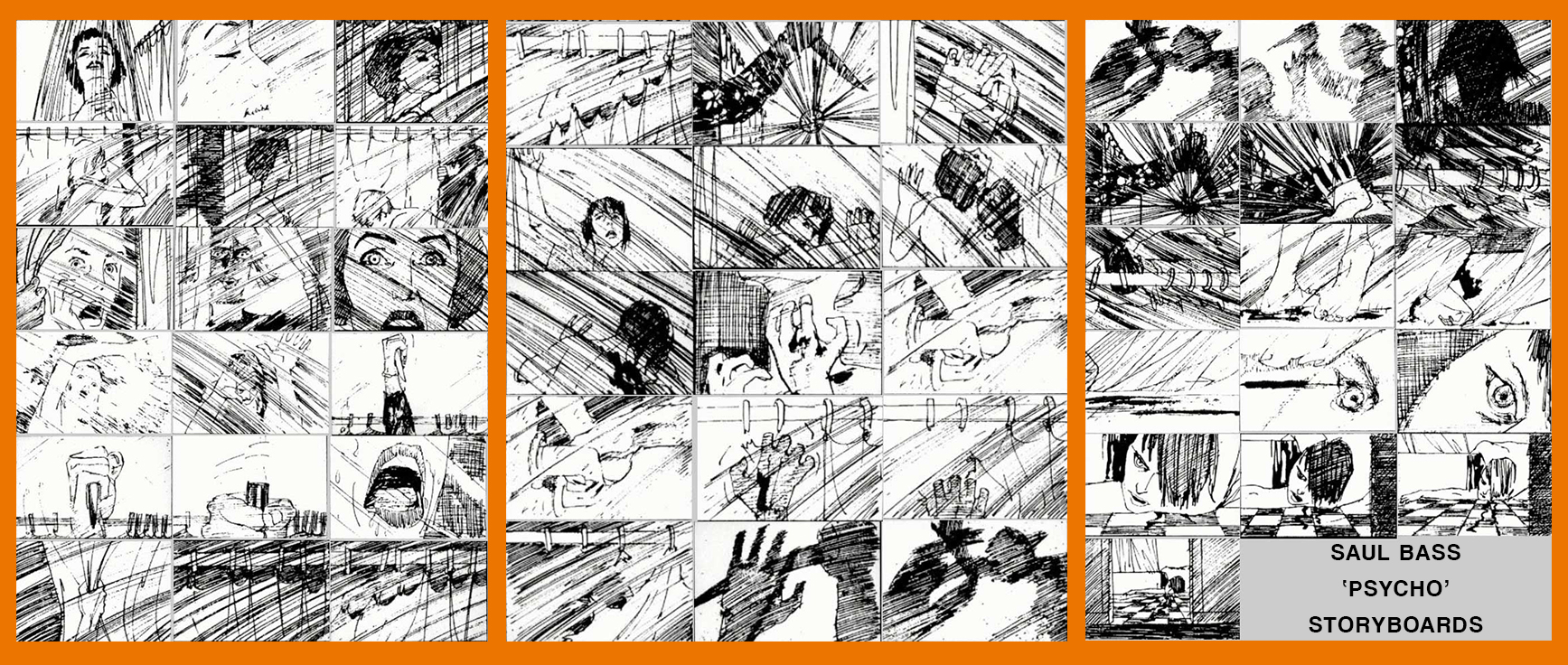
Image source: VashiVisuals.
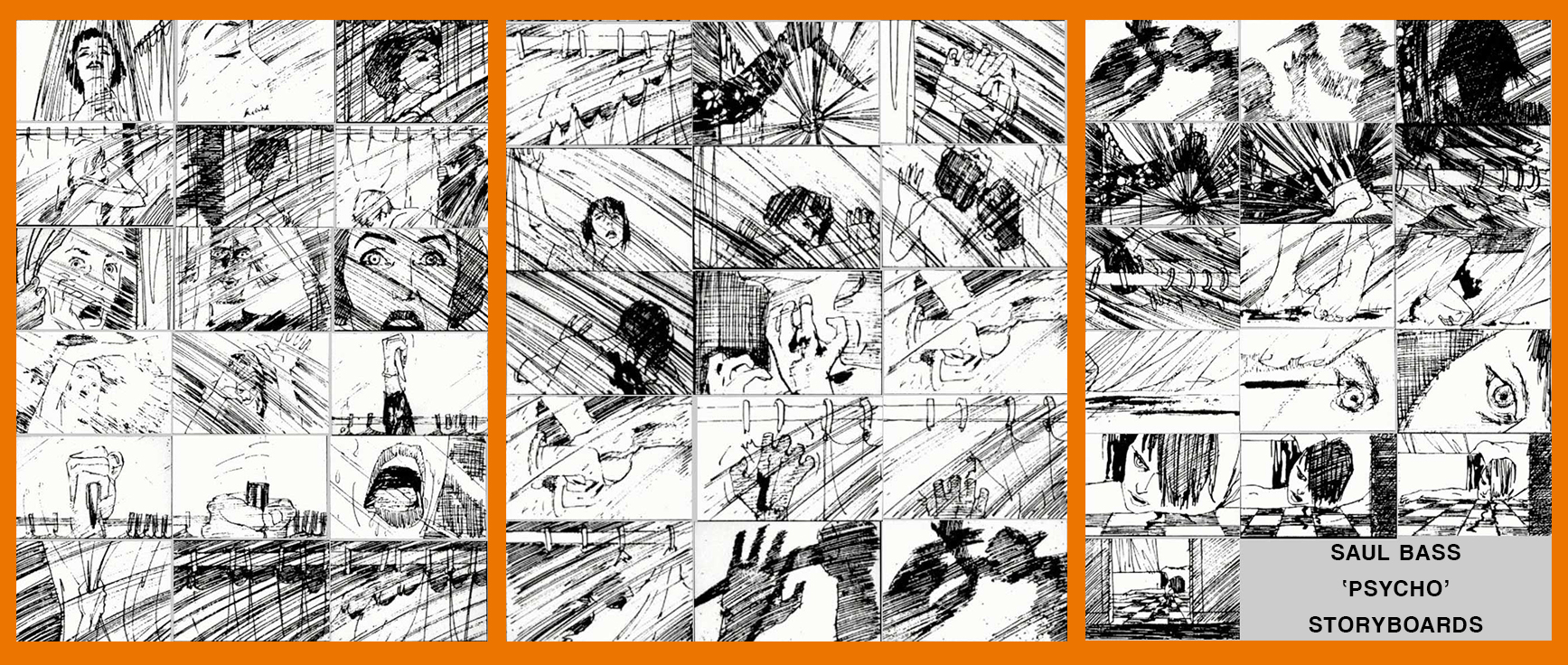
The boards matter because the scene is not built around graphic visibility. It is built around implication. The camera sees fragments: a face, a hand, water, a curtain, a knife, a body turning, a drain. The terror lives between the shots.
That makes the boards a lesson in editing. They do not simply show what happens. They show what the audience should think happened.
Why it works:
- The sequence is planned as a chain of impressions.
- The violence is carried by rhythm and association.
- Each shot has one job.
- The board understands that an edit can be more frightening than an image.
What filmmakers can learn:
When a scene depends on suspense, board the withholding. Decide what not to show. The audience’s imagination is a production asset when the sequence gives it the right fragments.
Source note: History.com’s account of the scene describes the consultation with Bass and the close-up-driven design of the sequence. See Psycho’s Shower Scene: How Hitchcock Upped the Terror.
4. Star Wars: storyboards for impossible space geography
The original Star Wars trilogy needed audiences to understand battles that could not be filmed in the usual way. Ships dive, bank, fire, explode, and cross through space, but the viewer still has to know who is chasing whom and why each shot matters.
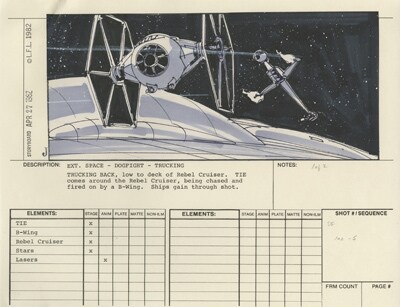
Image source: StarWars.com.
That is where the storyboards become crucial. The Abrams book Star Wars Storyboards: The Original Trilogy identifies a deep bench of artists, including Joe Johnston, Alex Tavoularis, Ivor Beddoes, Roy Carnon, and Ralph McQuarrie. Those names matter because Star Wars was not just inventing designs. It was inventing cinematic rules for those designs.
The best Star Wars boards are readable even before the effects exist. They break abstract space into pursuit, target, reaction, danger, and release.
Why it works:
- Complex VFX action is reduced to simple visual beats.
- Ships have direction, motivation, and screen position.
- The boards help effects, editorial, and sound imagine the same rhythm.
- The visual language feels mythic without becoming vague.
What filmmakers can learn:
If your sequence depends on imaginary objects, treat geography as sacred. Every ship, creature, vehicle, or generated element needs a screen relationship to something else. Otherwise the image may be spectacular and still be confusing.
Source note: the Abrams listing for Star Wars Storyboards: The Original Trilogy identifies the archive and the artists represented in the collection.
5. Alien: Ridley Scott’s Ridleygrams and the director’s private map
Ridley Scott is famous for drawing his own boards, often called “Ridleygrams.” On Alien, those visual plans helped communicate a tone that was hard to summarize: industrial science fiction, haunted-house suspense, body horror, production design, and survival drama inside one ship.
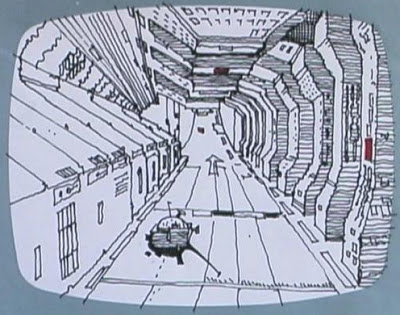
Image source: Alien-Covenant.com.
The legend around Alien storyboarding is not just that the boards were detailed. It is that they helped sell the film’s seriousness. A studio can read a script and understand the plot. A board can make the studio feel the movie.
The Alien boards work because they are atmospheric and practical at the same time. They tell the crew what kind of world this is: cramped, used, dark, mechanical, and hostile. They also give the camera a way through that world.
Why it works:
- The boards communicate texture and mood before production design is complete.
- The frame keeps the human body small against the machine.
- The drawings help the film feel designed from the inside out.
- The boards bridge art direction, suspense, and budget persuasion.
What filmmakers can learn:
Boards are not only for action. They can sell mood. If the tone of your project is hard to explain, draw the world until the tone becomes obvious.
Source note: fan archive writing on Alien collects early “Ridleygram” discussion and connects it to Scott’s pre-production visual presentation. See Alien Unseen Part One: Ridleygrams.
6. Ran: Akira Kurosawa paints the war before filming it
Akira Kurosawa’s painted storyboards for Ran are among the most beautiful storyboard examples in cinema. They are not rough continuity thumbnails. They are color, weather, movement, costume, staging, and tragedy compressed into single images.
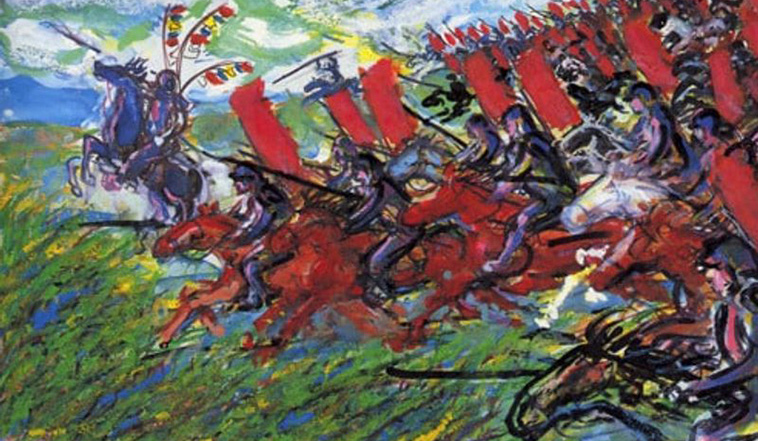
Image source: The Mind Circle.
The power of the Ran boards comes from their painterly certainty. Kurosawa was not merely working out where to put the camera. He was working out how color would carry meaning. Armies, banners, smoke, landscape, armor, and blood all become part of a visual grammar.
These boards are especially useful for filmmakers because they prove that storyboarding can be emotional design. A board can show a battlefield, but it can also show fate.
Why it works:
- Color is treated as structure, not decoration.
- Composition gives the audience a moral and emotional position.
- The paintings make scale legible without losing human consequence.
- The board helps departments align around a single visual destiny.
What filmmakers can learn:
If color matters, board in color. If atmosphere matters, board atmosphere. If the sequence is supposed to feel doomed, triumphant, feverish, or sacred, the frame should say so before production begins.
Source note: RAN: Original Storyboards collects Kurosawa’s screenplay and storyboards; see the Designers & Books entry.
7. Blade Runner: Sherman Labby and the architecture of mood
Sherman Labby’s Blade Runner storyboards show how production illustration can support a film where the world is as important as the plot. The movie’s future Los Angeles is not just a background. It presses on every character.
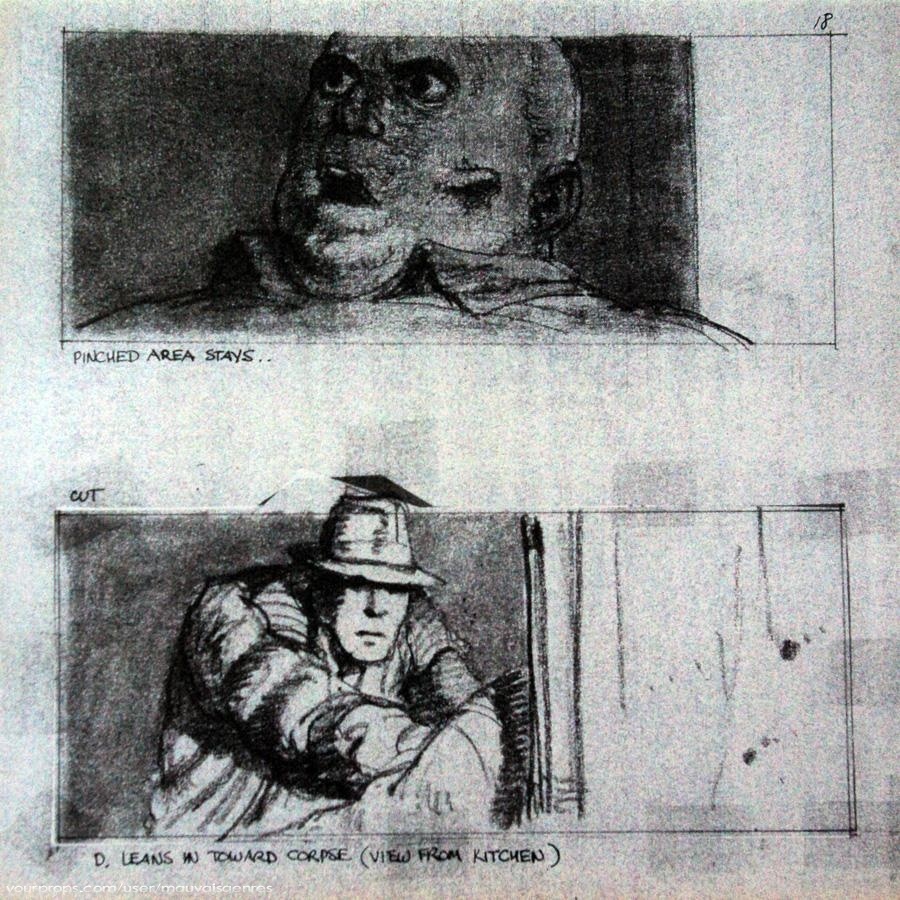
Image source: Shot by Shot.
Labby’s boards are valuable because they think in light, shadow, architecture, and negative space. The images help the viewer feel that the city has weight. In a film built from smoke, rain, neon, corporate scale, and human loneliness, that matters.
Unlike a simple action board, a Blade Runner board has to preserve atmosphere. The question is not only “What happens next?” It is “What does this world do to the person inside the frame?”
Why it works:
- The boards use contrast and scale to express alienation.
- The environment is active, not passive.
- The camera sees characters through architecture and light.
- The drawings help the film hold a noir mood inside science fiction.
What filmmakers can learn:
When the world is the story, storyboard the pressure of the world. Do not draw only the character. Draw the ceiling height, window glare, crowd density, weather, signs, shadows, and the emotional trap around them.
Source note: ACMI identifies Sherman Labby storyboards in its collection, including Blade Runner material. See ACMI’s Sherman Labby storyboards entry.
8. Jodorowsky’s Dune: Moebius and the unmade movie that still moved cinema
Alejandro Jodorowsky’s unmade Dune is one of the most famous storyboard legends in film history. Jean “Moebius” Giraud worked with Jodorowsky to visualize the film in a vast storyboard/script book that helped define the project even though the movie itself was never produced.
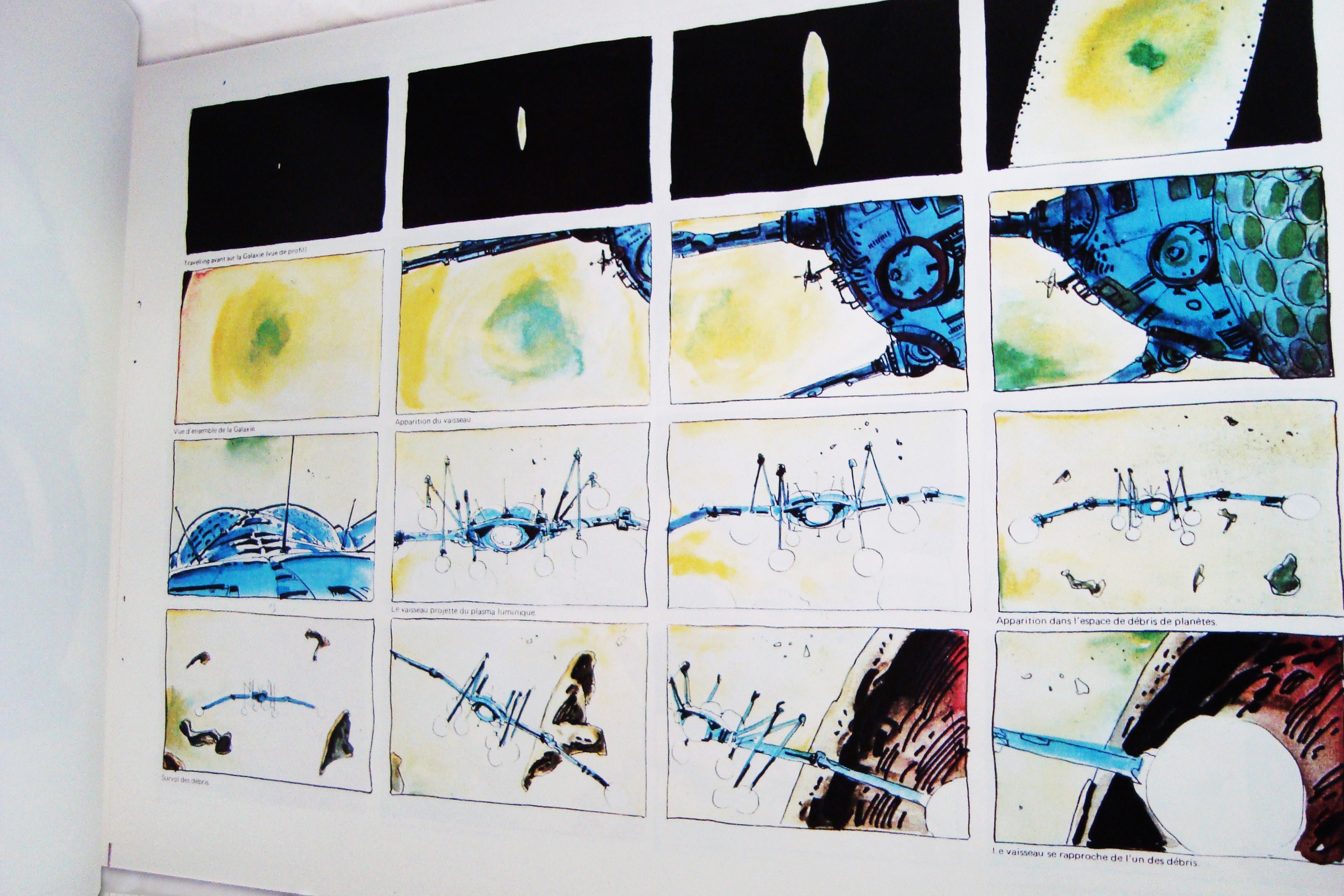
Image source: Dune Storyboard Archive.
That makes it a different kind of example. These boards did not solve a production that reached the screen. They preserved a film that existed most completely in planning.
The lesson is still enormous. The Dune book treated the storyboard as a world bible, pitch document, visual script, and proof of ambition. It showed that previsualization can carry influence even when the film collapses.
Why it works:
- The boards turn an enormous novel into a sequence of cinematic images.
- Moebius’s line gives the project a distinct visual intelligence.
- The book makes the movie easier to imagine than a treatment could.
- The artifact became part of film history despite the production’s failure.
What filmmakers can learn:
If a project is hard to fund, explain, or align around, boards can become persuasion. A clear visual document can make an impossible project feel strangely concrete.
Source note: the surviving Dune storyboard book is widely discussed through the documentary and archival fan work; see the Jodorowsky’s Dune storyboard archive.
9. The Matrix: comic-book boards as proof of a new film language
The Matrix needed viewers, financiers, actors, stunt teams, and VFX crews to understand action that did not yet have a familiar mainstream vocabulary. Bullet time, wire work, anime influence, martial arts, simulation logic, and cyberpunk design all had to live inside a coherent movie.
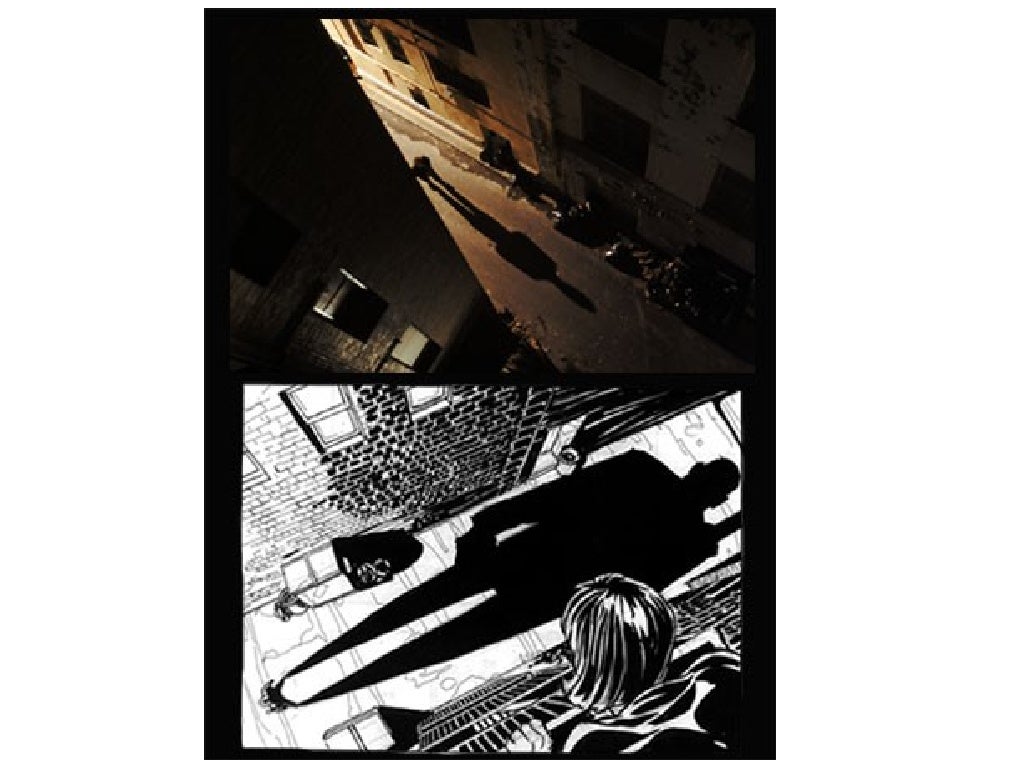
Image source: Storyboards for The Matrix on SlideShare.
The storyboards helped. Steve Skroce is closely associated with the black-and-white principal storyboard art, with Tani Kunitake credited for color storyboard work in The Art of The Matrix catalog record, alongside conceptual work from Geof Darrow and others.
The best Matrix boards read with comic-book force. That is not a weakness. It is exactly why they are useful. The panel-to-panel logic helps the audience understand speed, impact, pause, reversal, and impossibility.
Why it works:
- The boards make complex action legible before the stunt or VFX pass.
- Comic-book panel grammar fits the film’s heightened reality.
- Every impossible beat gets a visual argument.
- The boards helped communicate a new action style to people who had to build it.
What filmmakers can learn:
If your film language is unfamiliar, do not rely on text alone. Draw the new grammar. Show the pause, the pivot, the camera axis, the impossible motion, and the cut.
Source note: the College for Creative Studies catalog record for The Art of The Matrix lists principal storyboard art by Steve Skroce and color storyboard art by Tani Kunitake. See The Art of The Matrix catalog entry.
10. Mad Max: Fury Road: the action film as a storyboard engine
Mad Max: Fury Road is one of the modern masterpieces of storyboard-driven filmmaking. George Miller’s film is famous for being designed visually before conventional dialogue-heavy script logic took over. The movie moves like a chase because, at the planning level, it was built as images, movement, cause, effect, and escalation.
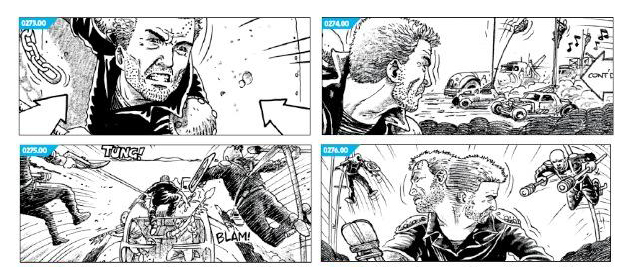
Image source: SlashFilm.
Peter Pound’s official site notes his major contribution to Fury Road, including hundreds of storyboard frames and principal vehicle design work. Brendan McCarthy and other artists were also central to the film’s visual development and board-driven structure.
What makes the boards amazing is the clarity of motion. Even when the finished film becomes overwhelming, the viewer knows the road, the convoy, the pursuers, the objective, and the danger. The boards protected that clarity.
Why it works:
- Action is planned around geography and momentum.
- Vehicles have readable silhouettes and tactical roles.
- The board structure supports editing without losing orientation.
- The film’s minimal dialogue makes visual planning carry more narrative weight.
What filmmakers can learn:
For action, clarity is more important than density. A scene can be wild, loud, fast, and still readable if the board protects the path of movement.
Source note: see Peter Pound’s official portfolio for his Fury Road contribution.
11. Spirited Away: Hayao Miyazaki and the storyboard as screenplay
In Hayao Miyazaki’s work, storyboards often feel less like production paperwork and more like the movie discovering itself. Spirited Away is a perfect example because the world unfolds with dream logic, but the visual progression remains precise.
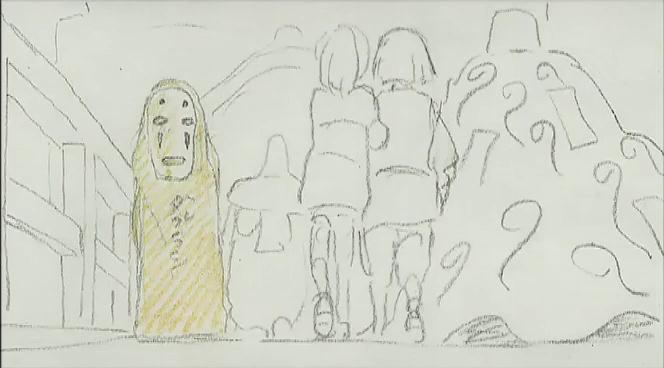
Image source: Oh-Totoro.
The Studio Ghibli Complete Storyboard Collection for Spirited Away credits Miyazaki, and the existence of a dedicated storyboard volume shows how central the boards are to understanding the film. In animation, the storyboard is not a loose suggestion. It is the spine that timing, layout, performance, background, and editing all grow from.
What makes these boards amazing is their patience. Miyazaki lets Chihiro encounter the world gradually. The boards protect wonder by controlling the pace of revelation: empty tunnel, abandoned food stalls, impossible bathhouse, spirit traffic, labor, rules, fear, courage.
Why it works:
- The board process lets the world reveal itself step by step.
- Character emotion stays anchored inside visual discovery.
- Quiet moments receive as much attention as spectacle.
- The boards hold tone without over-explaining mythology.
What filmmakers can learn:
If your story depends on wonder, board discovery. Let the audience learn through spatial experience, not exposition. A character entering a room can be more powerful than a paragraph explaining the room.
Source note: see the CDJapan listing for Studio Ghibli Complete Storyboard Collection 13: Spirited Away.
What these famous storyboards have in common
The films above are wildly different, but their boards share a pattern: they solve specific production questions.
| Production question | Example that answers it |
|---|---|
| How do we show impossible scale? | Gone with the Wind, Ran |
| How do we make characters act before animation starts? | Snow White, Spirited Away |
| How do we imply violence without showing everything? | Psycho |
| How do we make VFX action readable? | Star Wars, The Matrix |
| How do we sell tone before the film exists? | Alien, Jodorowsky’s Dune |
| How do we keep action geography clear? | Mad Max: Fury Road |
| How do we make the world press on the character? | Blade Runner |
That is the deeper lesson. A storyboard is not a general-purpose drawing. It is a decision tool.
How to use these lessons in your own storyboards
If you are building storyboards for film, animation, commercials, or AI video, start by deciding what kind of board your sequence actually needs.
If the scene is about scale
Study Gone with the Wind and Ran. Draw the relationship between people and environment. Make the audience feel size, distance, height, weather, or battlefield order before adding detail.
If the scene is about fear
Study Psycho and Alien. Board what the audience sees, what they almost see, and what they have to imagine. Suspense is often a sequence of incomplete information.
If the scene is about action
Study Star Wars, The Matrix, and Mad Max: Fury Road. Keep direction, pursuit, target, obstacle, and consequence visible. A beautiful action image is not enough if the viewer cannot follow the move.
If the scene is about a world
Study Blade Runner, Spirited Away, and Jodorowsky’s Dune. Draw the environment as a character. Decide how architecture, atmosphere, props, and background motion change the emotional meaning of the shot.
If the scene is for AI video
Translate each panel into a shot plan before generation. A usable AI video storyboard should carry:
- Shot purpose.
- Subject and action.
- Framing.
- Camera movement.
- Lighting and atmosphere.
- Character, location, prop, and wardrobe references.
- Start or end frame anchors.
- Negative constraints.
- Review criteria.
That is where the storyboard becomes more than inspiration. It becomes production context.
The AI filmmaking workflow guide shows how those boards connect to the larger process, and the AI animation generator workflow explains how storyboard logic changes when the final footage is generated rather than hand-animated or shot on set.
A simple storyboard study exercise
Pick one famous storyboard sequence and do this:
- Watch the finished scene once without pausing.
- Write down the scene’s job in one sentence.
- Look at the boards or available frame comparisons.
- Mark what each panel solves: geography, emotion, timing, reveal, action, or design.
- Rebuild the sequence as a five-shot plan in your own words.
- Write one sentence explaining why the sequence would be weaker without boards.
This exercise is especially useful for directors, producers, storyboard artists, cinematographers, editors, and AI filmmakers. It forces you to see the storyboard as a chain of decisions instead of a gallery of cool images.
How to build storyboard references for your own film
Storyboard references work best when they are organized by problem, not by taste. A folder called “cool shots” is less useful than a reference set for “wide desert pursuit,” “one-room argument,” “creature reveal,” or “child enters unfamiliar world.”
For each reference, capture the production lesson:
- The source film and sequence.
- The shot type or camera position.
- The action beat the panel explains.
- The continuity detail that must carry forward.
- The emotional effect of the frame.
- The practical reason the board exists.
Then turn the reference into your own shot language. For example, a Psycho reference might become “use fragmentary close-ups to imply danger without showing impact.” A Fury Road reference might become “keep every vehicle’s direction and objective readable before adding chaos.” A Blade Runner reference might become “let architecture and weather trap the character.”
This is especially important for AI filmmaking. Model outputs can look impressive while drifting away from the scene’s job. A storyboard reference gives you something concrete to test against: did the generated take preserve the framing, action, continuity, and mood the shot needed?
For a fuller production setup, the AI movie maker guide covers project-level planning, and the character consistency workflow explains how references keep performers, wardrobe, and visual identity stable across shots.
Turn inspiration into production structure
The best storyboards in film history have one thing in common: they carry creative intent into production. They help people make the same movie before the movie exists.
Lotix is built for the modern version of that problem. Instead of letting references, prompts, generated clips, and review notes scatter across folders, Lotix organizes AI video work into projects, production assets, sequences, scenes, shots, takes, and dailies.
Use famous storyboards for inspiration. Then give your own boards a production system:
- Put every panel inside a scene.
- Give every shot a purpose.
- Attach the references that matter.
- Generate takes against the shot plan.
- Review the output against the original intent.
- Keep selected and approved takes in dailies.
When your storyboard becomes a real production plan, sign up free and keep the path from idea to shot to take visible.
Frequently asked questions
What are the most famous storyboard examples?
Some of the most famous storyboard examples come from Gone with the Wind, Psycho, Star Wars, Alien, Ran, Blade Runner, Jodorowsky’s Dune, The Matrix, Mad Max: Fury Road, and Studio Ghibli films such as Spirited Away. They are famous because they show how visual planning can shape production, not just decorate it.
Who is the most famous storyboard artist?
There is no single answer. Saul Bass, Joe Johnston, Sherman Labby, Jean “Moebius” Giraud, Steve Skroce, Peter Pound, and many Disney and Studio Ghibli story artists are all important depending on the film tradition you study. Some directors, including Akira Kurosawa, Hayao Miyazaki, and Ridley Scott, are also famous for drawing or closely controlling their own storyboards.
Are storyboards only used for action scenes?
No. Action scenes often need boards because geography and timing are difficult, but storyboards are just as useful for horror, comedy, animation, visual effects, production design, and quiet character moments. Any scene that depends on visual order can benefit from boards.
What is the difference between a storyboard and concept art?
Concept art explores the look of a world, character, prop, or mood. A storyboard explains how shots unfold over time. Some images can do both, but the storyboard’s main job is sequence logic: what the viewer sees first, what changes, and what the next image must answer.
How do storyboard examples help AI video production?
Storyboard examples help AI video teams define shot intent before generation. A panel can become a structured shot plan with references, prompts, camera notes, constraints, and review criteria. That makes it easier to judge whether generated takes serve the scene instead of merely looking interesting.
What are good movie storyboard examples for beginners?
Beginners should start with sequences where the visual problem is clear: Psycho for suspense and editing, Star Wars for screen direction and VFX geography, Mad Max: Fury Road for chase action, and Spirited Away for discovery and animated performance. These examples make it easy to see why one shot follows another.
What is the difference between storyboarding examples and storyboard references?
Storyboarding examples usually teach a process or technique, such as how to plan action, suspense, or animation. Storyboard references are source materials you collect for your own project, such as famous film boards, frame comparisons, shot lists, production art, or stills that clarify the kind of scene you want to build.
Free workspace
Create your free Lotix workspace.
Plan your shots, manage your assets, generate takes with built-in Seedance, and keep generation spend visible with monthly tokens inside Lotix.
- Plan shots around scenes, references, and review needs
- Manage characters, locations, props, and production assets
- Generate Seedance takes with visible token usage